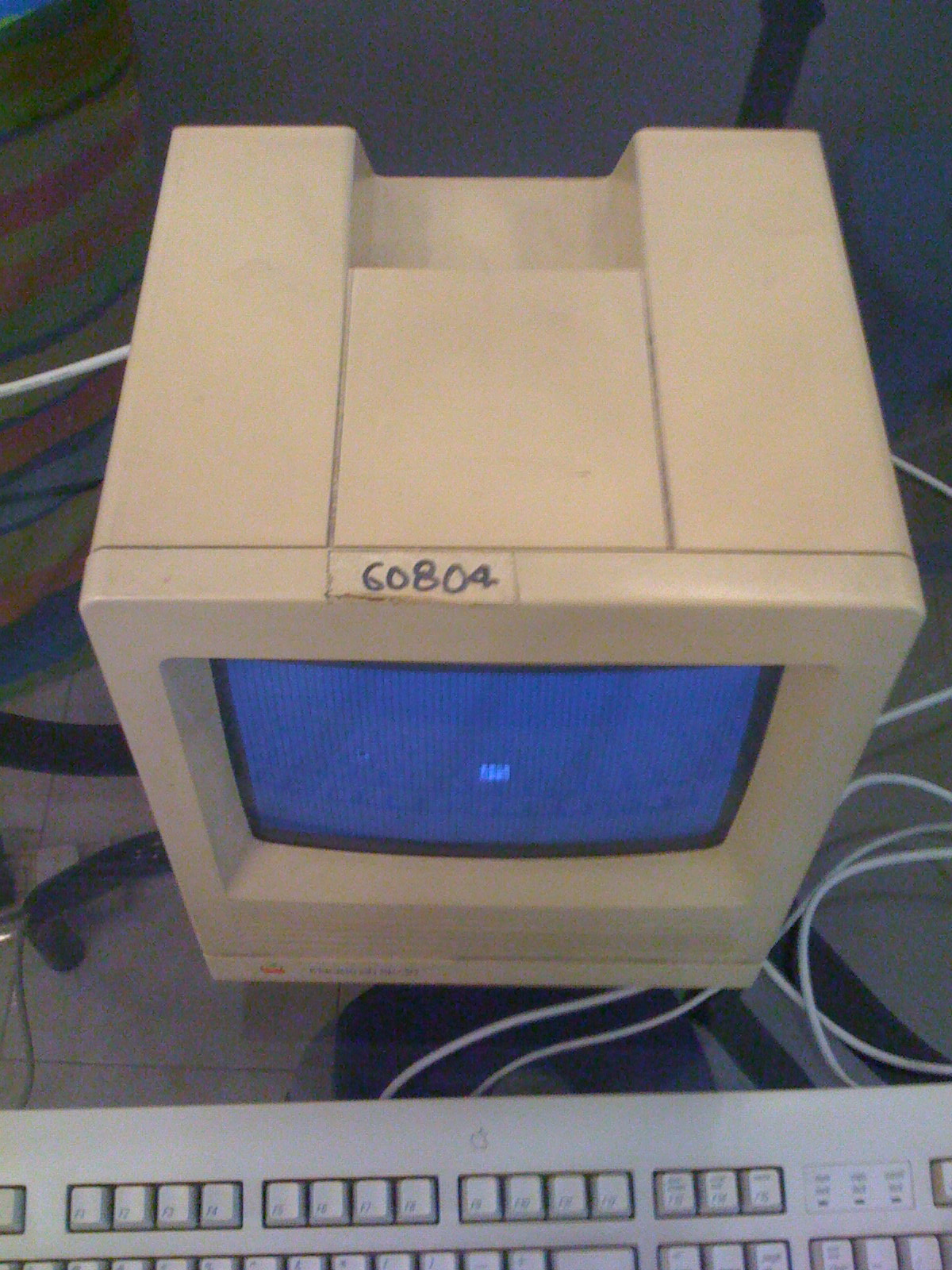
Launched on 19th January 1989, it was the most powerful of all the Compact Macintosh models. Inside the case was a 9 inch black and white screen with a 16 mhz 68030 processor, 1mb of ram, 40 mb hard drive and a 1.44mb floppy drive.
In those days, floppy disks came in SD (Single Sided), DS (Double Sided) and HS (High Density) formats. The storage size are 400 kb, 800kb and 1.44 mb respectively. The SE/30 had a Superdrive and could read all formats. It’s a great machine to copy data and troubleshoot older macs.
Internal hard drives came standard at 40 mb but there was an option to upgrade it to 80 mb. To replace or upgrade the drives, you will need to find one with a SCSI interface. The Macintosh SE/30 can take up to a large 3.5 inch half height SCSI drive.
There were 8 ram slots allowing it to be upgraded to a gigantic 128 mb through 16 mb 30 pin SIMMs. For the system to access more than 8 mb of ram, you will need to install a software patch from Apple called Mode32. The reason for this was that the ROMs in the SE/30 contained 24-bit code thus rendering it impossible to run 32-bit applications.
Although this computer had a black and white screen, there was an expansion slot. The PDS slot had 120 pins allowing the option of adding a network card or colour graphics card. This expansion slot is different from that found in the Macintosh SE.
As one of the most upgradeble and powerful compact Macintosh, many were used as servers or workstations. It’s usability sure makes it a must have for every Mac collector.